How to Get on a Board of Trustees
You've applied for several advertised trustee vacancies. Your executive CV is polished, your experience is substantial, and the silence from boards is starting to feel personal. It usually isn't. A trustee vacancy isn't a job opening waiting for the most impressive résumé. It exists because a board needs a particular contribution, and the people who appoint trustees need to see how you'll help them govern.
The practical answer to how to get on a board of trustees is to start with the board's composition, then build a relationship and make a focused case for your fit. Your experience matters, but only when you translate it into the oversight, judgment, perspective, or committee expertise that a specific board is missing.
Table of Contents
- Reframing the Goal as Solving a Board Gap
- How Trustee Recruitment Actually Works
- Building a Shortlist of Target Organizations
- Translating Executive Experience into Governance Evidence
- Relationship Mapping and Application Preparation
- Preparing for the Trustee Interview
- Eligibility, Due Diligence, and Your First 90 Days
Reframing the Goal as Solving a Board Gap
A senior finance leader has applied to five advertised charity trustee roles and heard nothing back. Their CV shows years of financial leadership, but it asks the board to do the work of figuring out why that experience matters to its current needs. The problem may not be a lack of qualification. It may be that the candidate hasn't shown a chair the governance contribution they'd bring to this board.
A chair looking at a skills matrix isn't trying to collect impressive career histories. They're trying to understand whether the board has the expertise and perspective it needs to oversee the organization. One board may need stronger audit and financial oversight. Another may be missing technology governance, community knowledge, or experience working with public institutions. A board-ready candidate connects their experience to the gap, not just to their job title.

Think of trustee recruitment in the right order: governance fit first, relationships second, paperwork last. A polished CV can help a chair assess you, but it can't create a fit where none exists. A warm introduction can get your profile in front of a decision-maker, but it won't substitute for judgment, time capacity, or a credible reason to serve.
A trustee isn't recruited because they want a seat. They're recruited because the board sees a governance need they can help meet.
Start by asking what this organization needs its board to do well. Then connect your experience to that need with evidence. The shift is from “I'd like to join a board” to “Here's the oversight perspective I can contribute to this board.” That's a more useful conversation for a chair, and a more honest way to assess whether the role makes sense for you.
How Trustee Recruitment Actually Works
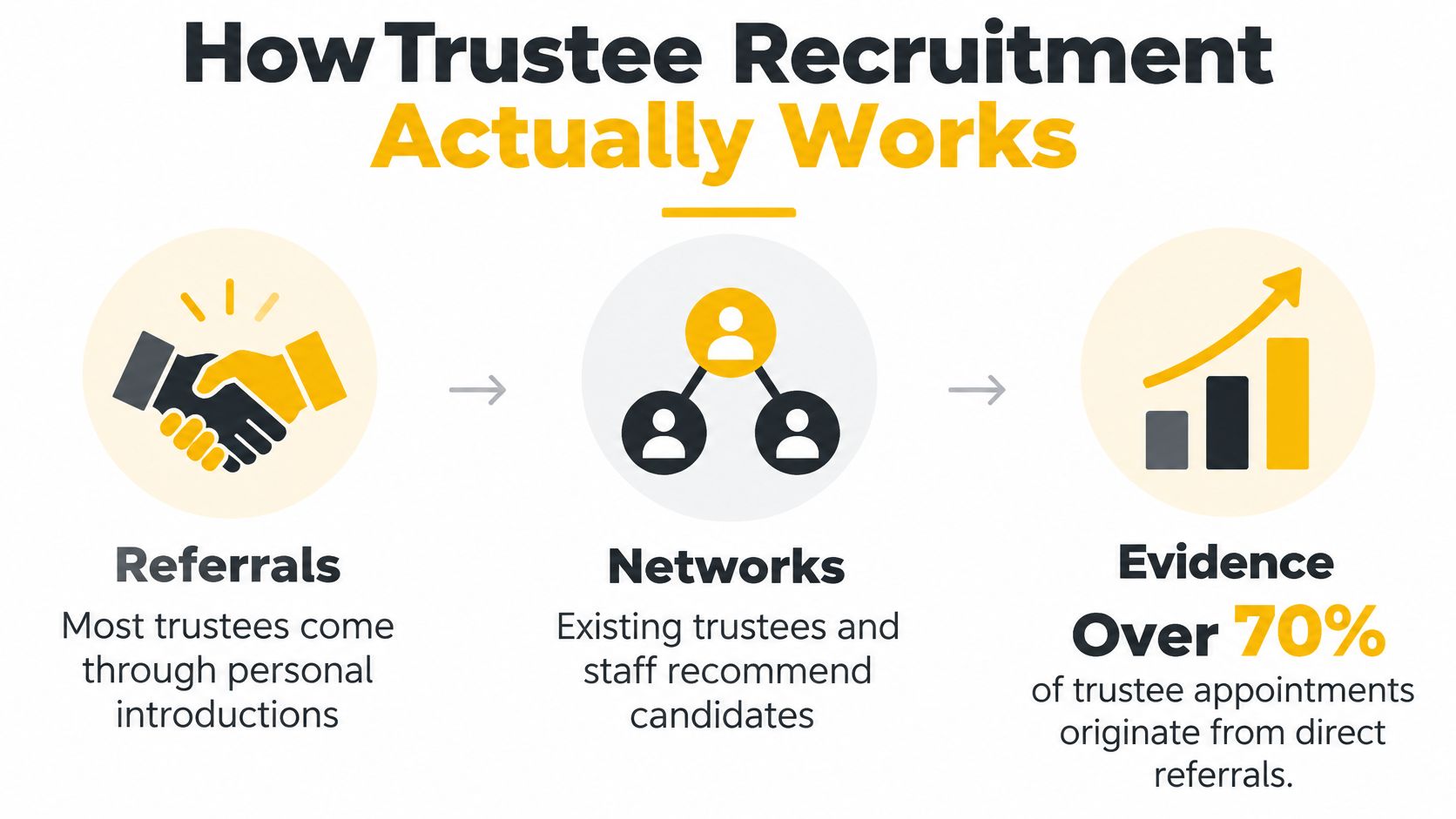
Trustee recruitment is heavily relationship-mediated. In research cited by the UK Charity Commission and Pro Bono Economics, only 6% of trustees said they applied through an advertisement, while more than half of charities relied on personal contacts when recruiting. The same research found that 29% were asked to join by the chair and 25% by another board member (UK Charity Commission recruitment guidance). Advertised vacancies still matter, but they're only one visible route into a process that often starts through people who already know the organization or its board.
U.S. nonprofit evidence shows a similar pattern. 96% of boards identified board members' personal or professional networks as a way to find prospective directors, and 88% cited the chief executive's network (BoardSource's nonprofit-sector research). That doesn't mean you should abandon applications. It means you shouldn't mistake a vacancy listing for the whole recruitment market. A strong campaign combines applications with well-targeted introductions and a clear explanation of your governance fit.
At the same time, boards often struggle to fill vacancies. 85% of respondents to an NCVO survey considered recruitment somewhat or very difficult, and 68% of micro charities described it as very difficult, compared with 57% of small charities, 45% of medium charities, and 18% of large or major charities (NCVO's trustee recruitment research). Smaller organizations may offer more accessible entry points, but accessibility isn't a reason to overlook due diligence. A vacancy that's hard to fill can signal an urgent need, an unclear role, or a demanding workload. Find out which before you commit.
A high-profile board can look like the obvious target, but prestige doesn't tell you whether your contribution is wanted or whether the organization is a good fit. Build a pipeline around need, access, and mission rather than status alone. If you're comparing a supported search with a traditional executive-search route, review how board placement differs from executive search firms.
Building a Shortlist of Target Organizations
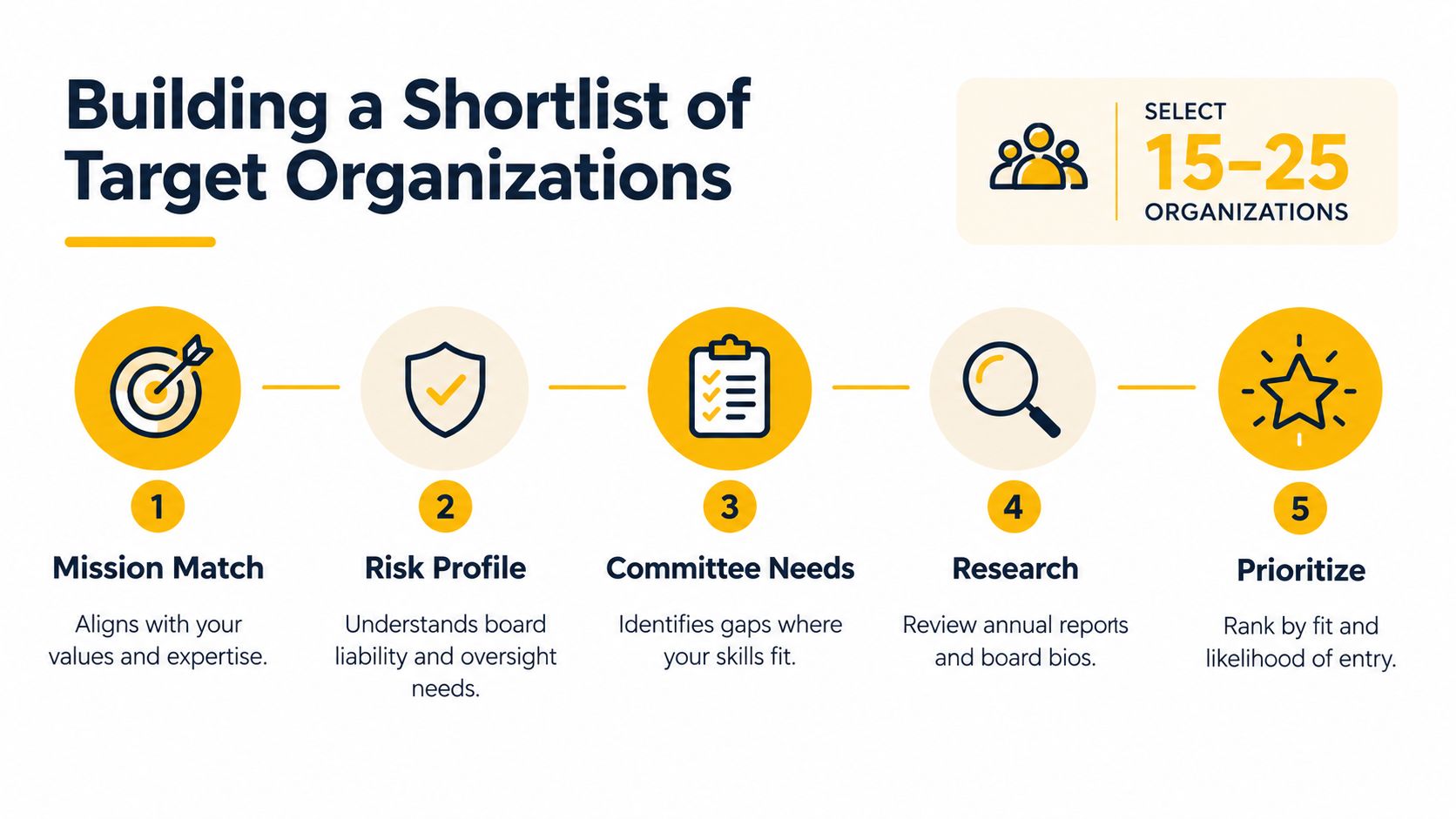
Don't start by sending the same introduction to every organization you admire. Build a working list of 15–25 targets whose mission, risk profile, and likely governance needs connect to your experience. A shorter, researched list gives you a reason to contact people and a basis for asking intelligent questions.
For each organization, look beyond its mission statement. Read the annual report and trustees' report, review trustee biographies, identify committees, and look for public signals about strategic priorities, financial oversight, technology, growth, regulation, or community engagement. Note the chair and the nominating or governance committee if the organization identifies one. Where the board publishes a skills matrix, compare it with your expertise instead of assuming your seniority will speak for itself.
Recruitment gaps vary by organization. NCVO reports that 49% of surveyed charities lacked marketing and communications skills, 41% lacked legal skills, 41% lacked technology skills, and 35% lacked financial expertise (NCVO's analysis of trustee vacancies). These figures are a prompt to investigate, not a substitute for researching an individual board. Don't assume a charity needs your skill because other charities do.
Use a simple shortlist record with fields for mission fit, likely board gap, committee structure, likely turnover, potential introductions, and next action. Rank each organization by the strength of your evidence and access, not by how recognizable its name is. If you can't describe a plausible governance contribution in a sentence, keep researching before you reach out.
Some candidates will also weigh paid roles against voluntary trusteeships. Be clear about the type of seat you're pursuing, and use a focused list of board of directors positions to explore relevant openings without confusing corporate directorships with charitable trusteeships. The responsibilities and appointment rules can differ, so identify the role before tailoring your approach.
Translating Executive Experience into Governance Evidence
Your CV shouldn't read like an application for your next operating job. A trustee board needs to understand how you oversee, challenge, and make decisions collectively, not how quickly you can step in and run a department. Translate achievements into evidence of governance judgment, then show how that evidence relates to a board or committee need.
| Executive Background | Common Board Gap | Governance-Formatted Evidence |
|---|---|---|
| CFO | Audit, finance, or risk oversight | Led financial oversight and worked with audit processes, helping decision-makers assess risk and accountability. |
| CMO | Stakeholder engagement or community perspective | Built relationships with varied stakeholder groups and used their perspectives to inform decisions. |
| CTO | Cybersecurity, data, or technology governance | Oversaw technology risk and helped leaders assess controls, resilience, and data-related decisions. |
These examples need to be truthful to your experience. Don't claim committee expertise because you've worked in the function. Distinguish between operational responsibility and board-level oversight. If you haven't served on a board before, say what you've done that demonstrates judgment, constructive challenge, risk awareness, or accountability in a comparable setting.
Write for a chair, not a recruiter
A CV line such as “Managed a large finance team” tells a chair little about how you'll contribute as a trustee. A stronger version might say, “Provided financial oversight and challenged assumptions in planning discussions, with attention to sustainability and risk.” Use that wording only if it accurately describes your work.
Your cover note should make the fit explicit: name the organization's apparent need, connect it to relevant evidence, and explain the stakeholder perspective you'd add. Avoid generic claims about being passionate or a team player. They don't show why this board should consider you.
Draft a one-page director thesis
Keep a concise note covering relevant competencies, stakeholder perspective, independence, time capacity, and potential conflicts. This is your working case for fit, not a sales brochure. It should help you answer a chair's practical question: why this candidate for this board, at this point?
For more help distinguishing governance-format materials from ordinary career documents, compare board-coach and CV-writing support. The standard is simple: every claim should help the board evaluate your ability to govern.
Relationship Mapping and Application Preparation
Networking becomes useful when you know whom you're trying to reach and what you want to learn. For each target, map current trustees, senior staff, funders, auditors, legal advisers, relevant professional associations, alumni, and people from shared prior employers. A contact doesn't need to be a close friend. They need a credible reason to help you understand the organization or connect you with someone who can.
Ask for intelligence and a specific introduction, not a vague promise to remember you. For example: “I'm assessing whether my audit and risk experience fits the board's needs. Could you tell me who leads governance recruitment, or introduce me to the chair if that seems appropriate?” Keep a record of whom you contacted, why they're relevant, the next action, and whether they responded. That turns networking into a managed process rather than a string of hopeful messages.
At an exploratory conversation, ask about the board's priorities, committees, time commitment, appointment route, and the skills it's seeking. Don't open by demanding a seat. If an application is appropriate, tailor your governance CV and cover note to the role, and prepare a concise committee-fit memo explaining the evidence behind your candidacy.
SeatSignal is the only DFY board placement program that hand-picks ideal board matches, drafts director-grade CVs for each role, and trains members specifically for each interview to help ensure they land the seat. It brings matching, relationship mapping, application preparation, and role-specific interview practice into one subscription. Plans are listed at $297 for two months, $742.50 for six months, and $1,188 for one year; every plan includes placement, planning, and shared support, beginning after checkout and onboarding. Coverage spans the United States, United Kingdom, Ireland, the European Union, Canada, Australia, New Zealand, and Singapore. These are service details, not a promise of appointment. Compare this supported process with running a board search yourself and choose a method that fits your time, budget, and need for assistance.
Preparing for the Trustee Interview
A trustee interview isn't a job interview. The chair isn't asking whether you can take over operations; they're assessing whether you can contribute independent judgment, respect management's role, and make decisions in the organization's interests. A polished answer about your career won't resolve concerns about conflicts, time, or how you behave when you disagree.
Prepare for the questions behind the questions:
- Judgment: How would you challenge a proposal when the evidence is incomplete or the board disagrees?
- Role boundaries: How do you distinguish oversight from running the organization?
- Conflicts: Which professional, financial, or personal relationships could affect your independence?
- Capacity: What meetings, committee work, and preparation can you realistically commit to?
- Contribution: What specific perspective or expertise would you bring to this board?
Rehearse a committee scenario connected to the role. An audit candidate might explain how they'd probe an unclear risk report without dictating management's response. A technology candidate might describe the questions they'd ask about oversight and accountability, rather than recommending a product from the board table.
If you lack sector or board experience, acknowledge it plainly and explain how you'll learn. Don't bluff. Prepare references who can speak to your judgment and conduct, and be ready to discuss your time capacity and conflicts before the chair has to drag those answers out of you. Board-ready preparation means demonstrating how you think, not just what you've achieved.
Eligibility, Due Diligence, and Your First 90 Days
Before accepting a seat, check that you can legally serve and that the organization is appointing you correctly. In England and Wales, government guidance states that a trustee must generally be at least 16 for a charitable company or charitable incorporated organisation, and at least 18 for another type of charity. The charity's governing document sets out how trustees are appointed and any relevant restrictions; review the official guidance on what charity trusteeship involves. Rules vary by jurisdiction and organization, so don't treat one country's requirements as universal.
Then examine the organization's governing document, conflicts requirements, indemnification arrangements, directors' and officers' insurance, financial condition, meeting load, and committee obligations. Clarify whether the seat is elected or appointed, and whether your relationships, outside roles, or commercial interests could impair your independence. An invitation isn't the same as a valid appointment, and enthusiasm isn't a substitute for understanding your fiduciary exposure.
Start with a disciplined learning plan
Use your first 90 days to learn the organization before trying to reshape it. Study its finances, mission, regulatory exposure, key board materials, and calendar. Meet relevant staff and trustees, understand how the board and committees work, and ask what information trustees rely on to make informed decisions. Your job is to protect and guide the organization, not to run it from the board table.
Before saying yes, make sure you can answer three questions: Am I eligible and properly appointed? Do I understand the duties, risks, and workload? Can I contribute to a real governance need while respecting management's authority? If any answer is unclear, get clarification before accepting. Candidates comparing formal governance education with practical placement support can review director institutes and board-preparation options, but training doesn't replace independent legal or financial advice when you need it.
No application strategy guarantees a match, an interview, an appointment, income, or completion within a particular timeframe. You remain responsible for your decisions and due diligence. A prepared candidate who understands the board's needs and can explain a relevant contribution is better positioned to make a credible case.
If you want practical support identifying suitable board matches, preparing director-grade application materials, and rehearsing for board-specific interviews, visit SeatSignal. Build your candidacy around the governance gap you can help fill, and approach every potential appointment with clear eyes about the responsibilities.
Want a paid board role, done for you?
One handpicked, verified open board role every week, with a director-grade packet tailored for it.
Get Started