Executive Interview Preparation That Lands the Board Seat
You've built a strong executive record, found a board opening that looks relevant, and started preparing the stories that usually work in a senior leadership interview. Then someone asks a different question: What capability does this board need, and how would your appointment improve its decisions? That's the moment many accomplished executives discover that a board interview isn't a résumé review with more senior interviewers.
Effective executive interview preparation for a board seat starts with the board, not your biography. You need to show where your experience fits, how you exercise independent judgment, and what the board would gain from adding you.
Table of Contents
- Why Board Interviews Feel Different From Executive Ones
- Mapping the Board Before You Draft a Single Answer
- Building a Question Bank Mapped to Board Competencies
- Turning Executive Wins Into Governance-Grade Evidence
- Preparing for AI and Technology-Governance Questions
- A 60-Minute Rehearsal Plan for the Day Before
- Closing Strong Without Asking the Wrong Questions
Why Board Interviews Feel Different From Executive Ones
A CFO preparing for her first public-company board might expect to lead with the transformation she ran, the risks she managed, and the results she delivered. Those achievements matter. But a chair may be listening for something else: how she challenged management, surfaced a risk, weighed competing interests, and contributed without crossing into day-to-day operations.
That distinction separates executive performance from governance judgment. A board wants evidence that you can ask hard questions, respect the line between oversight and management, and contribute something the current board needs. Confidence helps only when the answer demonstrates those qualities.
The boardroom test: Don't just explain what you accomplished. Show how your experience would improve this board's decision quality.
Director selection can involve several conversations with the executive chair, committee chair, and other directors, alongside a background review. The nominating and governance committee may assess candidates against the board's composition and oversight needs before recommending a nominee to the full board. That means a polished opening pitch isn't enough. Your account of a decision, disagreement, or failure needs to remain credible and consistent across different interviewers.
From résumé pitch to composition fit
A board interview isn't asking only, “Can this person lead?” It's also asking, “What would change if this person joined?” A candidate with deep financial expertise may be valuable to a board that needs stronger audit oversight, but the same expertise won't automatically make the candidate a fit if the board already has that capability and lacks technology or international experience.
Treat preparation as fit-mapping, not self-promotion. Identify the board's needs, connect your evidence to those needs, and be candid about what you don't bring. A general overview of board of directors positions can help you think about the range of roles and board contexts before narrowing your case to a specific opportunity.
Mapping the Board Before You Draft a Single Answer
Research the board before you write answers. Otherwise, you're likely to rehearse a convincing general pitch that could fit almost any company, which is precisely why it won't distinguish you.
Start with public materials and build a concise board brief. The aim isn't to collect facts for their own sake. It's to understand the organization's priorities, the board's current mix of experience, and the issues directors must oversee.
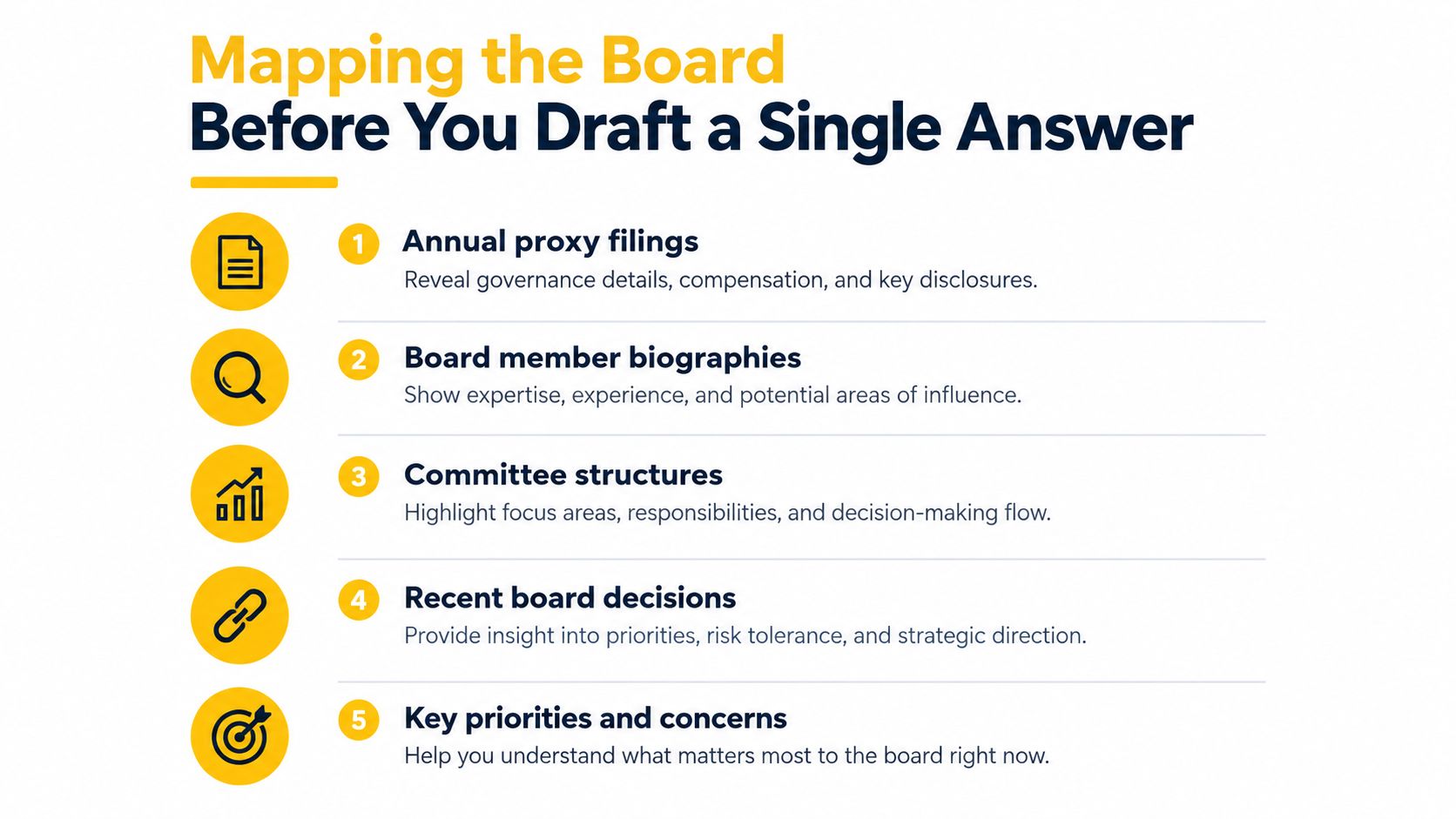
Build a one-page board brief
Use the company's annual proxy filing or equivalent governance disclosures to review director qualifications, committee assignments, independence, and how the board describes its composition needs. A board may spell out experience it values, or show through its skills matrix which capabilities are already well represented.
Then read committee charters and governance guidelines. These clarify where oversight responsibilities sit and help you distinguish a board-level question from a management-level task. Review recent results and earnings calls for strategic shifts, emerging risks, and management's stated priorities. Director biographies can reveal complementary expertise, overlapping experience, and the likely perspectives in the room.
| Research material | What to extract |
|---|---|
| Proxy filing and skills matrix | Stated qualifications, board composition, and possible capability gaps |
| Committee charters | Oversight responsibilities and the expertise relevant to the committee |
| Recent results and earnings calls | Strategic priorities, business risks, and issues management is emphasizing |
| Governance guidelines | Independence expectations, board practices, and director responsibilities |
| Director biographies | Existing expertise, likely interview perspectives, and areas of overlap |
Finish with a single page: board priorities, likely risks, relevant committee needs, potential capability gaps, and the evidence you can bring. Include a short note on what the board may need next, not just what it needs now. The board brief should feed your interview answers and any role-specific application materials.
Don't treat this as a hunt for a single “missing skill.” A board's composition is a collective design problem. Your case should explain both the capability you add and how you'll work constructively with directors whose expertise overlaps with yours. If you're comparing how different placement routes support that research and application work, review the distinctions between board placement support and executive search firms.
Building a Question Bank Mapped to Board Competencies
An unstructured conversation gives you room to talk, but it doesn't guarantee that you'll demonstrate what the board needs to assess. Structured interviews use consistent questions and evaluation criteria, which helps interviewers compare evidence more reliably. U.S. Office of Personnel Management guidance describes structured interviews as using standardized rules for eliciting, observing, and evaluating responses, typically against competencies identified through job analysis. Its research summary associates greater structure with stronger validity and rater reliability, more agreement among interviewers, and less adverse impact. OPM's structured-interview guidance supports a practical lesson for candidates: prepare against explicit competencies, not just a list of familiar prompts.
Build your question bank from the board brief. For each capability or concern, write likely questions that invite evidence of your judgment, not a recital of achievements. Make sure your answers address what you decided, the trade-offs you considered, and what you learned.
Use five governance domains
Map questions to strategy, financial and risk oversight, stakeholder judgment, independence and conflicts, and committee contribution. A meta-analytic review of interview research examined 245 validity coefficients representing 86,311 individuals and concluded that structured interviews were more valid than unstructured interviews. The review also found interview validity varied with question type, structure, whether an interview used a panel, and which work outcome was measured. The academic review reinforces why your preparation should cover both content and the way you present comparable evidence.
| Governance Domain | Likely Question | Competency Tested |
|---|---|---|
| Strategy | How would you assess whether this strategy remains sound if a key assumption changes? | Strategic judgment and scenario thinking |
| Financial and risk oversight | What information would you want before challenging management's assessment of a major risk? | Financial literacy and oversight discipline |
| Stakeholder judgment | How would you respond when stakeholder interests conflict? | Judgment, ethics, and stakeholder awareness |
| Independence and conflicts | How would you handle a situation where an outside relationship could affect your objectivity? | Independence and conflict management |
| Committee contribution | Which committee could make the strongest use of your experience, and why? | Role-specific expertise and board contribution |
Score each answer against relevance, governance judgment, evidence, brevity, and stakeholder awareness. A useful answer addresses the question, shows a decision or trade-off, provides specific supporting evidence, and stays focused on board oversight. If it relies on broad claims such as “I'm a strategic thinker,” revise it until the interviewer can see the judgment behind the label.
Use a few examples from director-training resources to test whether your answer is at the right level, but don't substitute a course or credential for demonstrated evidence. The distinction between director institutes and board-specific preparation is simple: preparation should help you make your case for this board, not just expand your general governance vocabulary.
Turning Executive Wins Into Governance-Grade Evidence
A senior executive's strongest story can still miss in a board interview. The usual version centers the candidate as the hero: “I took charge, drove the change, and delivered the result.” The board-level version explains what oversight judgment the experience demonstrates and how it could help directors make better decisions.
Build a situation–action–result evidence bank. For each story, briefly set the context, state the decision or action you took, then describe the result and the lesson relevant to oversight. Use only outcomes you can support. Don't inflate your role or invent metrics to make a story sound more impressive.

Rewrite the story for the boardroom
A growth story might begin as: “I launched the expansion and exceeded our target.” That describes execution, but it doesn't show what a director needs to hear. A governance-grade version explains the assumptions management tested, the risks raised, the alternatives considered, and what the candidate learned about disciplined oversight. Add verifiable outcomes when relevant, but don't let a metric replace the explanation of judgment.
A crisis story needs similar reframing. Instead of saying, “I managed the response,” describe how you established reliable information, escalated material risks, kept stakeholders informed, and recognized when independent advice was needed. The board wants to know whether you understand accountability and oversight, not whether you can tell a dramatic story.
For a stakeholder dispute, skip the victory lap. Explain the competing interests, the principles used to weigh them, the decision made, and how you protected trust or independence. Avoid implying that a director should step into management's role. Phrases like “I would ask management to show the evidence” or “I would test the assumptions” signal board altitude more clearly than “I would take control.”
Cut the heroics. Keep the judgment, trade-off, evidence, and lesson.
Prepare a compact bank of examples across growth, crisis, conflict, risk, and leadership. Rehearse each against the rubric from your question bank, and flag any story that depends on confidential details or unverifiable claims. Your strongest evidence is specific, discreet, and relevant to the board's needs.
Preparing for AI and Technology-Governance Questions
Many executives arrive ready to discuss strategy and leadership, then give an unconvincing answer about AI oversight. Boards don't need a candidate to predict which technology will win. They need a director who can challenge management's assumptions without turning governance into an operational bottleneck.
Technology oversight is both an opportunity and a capability question. In the cited 2025 board survey, 41% of directors identified generative AI in products and services as a major opportunity, 74% planned to increase investment in emerging technology, and roughly two-thirds planned to increase investment in cybersecurity, data privacy, and governance. The same survey reported that 13% of directors and 12% of management teams lacked the skills or experience needed to oversee emerging technology and cybersecurity effectively. Those findings create a clear interview opportunity for candidates who can connect technology fluency to disciplined oversight. (The 2025 board survey)
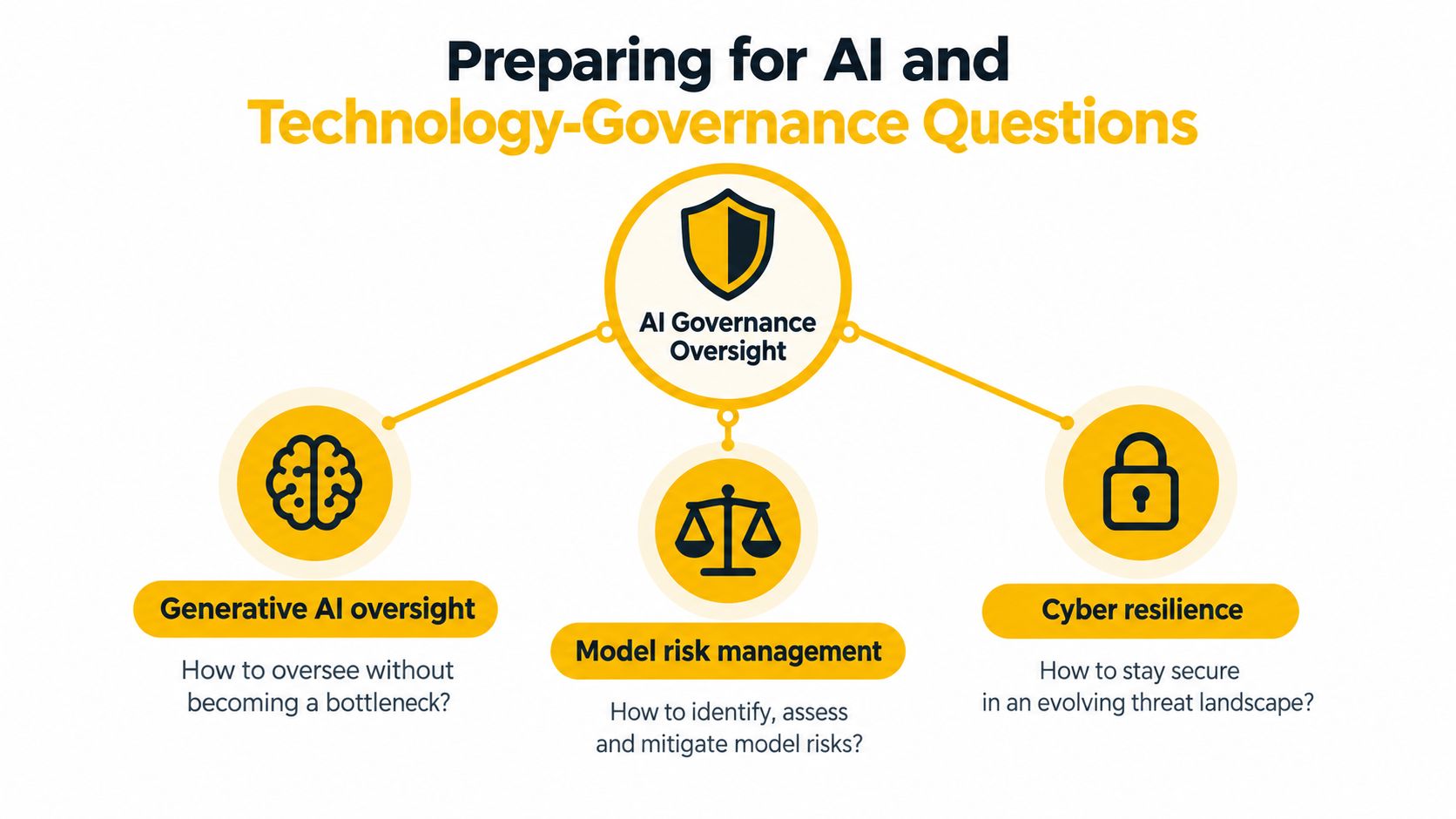
Answer with an oversight model, not a prediction
Expect questions about how the board should oversee generative AI, what information directors should receive about model risk, and how to challenge a business case built around new technology. A sound answer describes clear decision rights, reporting metrics, escalation thresholds, and independent assurance. The board sets expectations and tests risk and value; management remains responsible for implementation.
If management proposes an AI vendor, explain what you would ask about data provenance, privacy, security, resilience, regulatory exposure, accountability, and human oversight. Don't reject the proposal just because it's new, and don't endorse it because the opportunity sounds compelling. Ask how management will measure value, monitor failures, and escalate problems.
For a model-risk finding, describe what evidence you'd expect, who owns remediation, how the issue reaches the board, and what would trigger independent review. That answer signals calibrated skepticism: you recognize both the potential benefit and the need for accountability. Candidates who can do this well show the board that they can question technology enthusiasm without becoming technophobic or micromanaging.
A 60-Minute Rehearsal Plan for the Day Before
Use a fixed rehearsal rather than rereading your CV and hoping the right answer comes to mind. Structured preparation makes it easier to spot weak evidence and practice clear answers across different interviewers. A meta-analysis summarized in the MIT Sloan review of C-suite hiring mistakes notes that unstructured interviews are weak predictors when question variation and interviewer subjectivity make responses hard to compare. Prepare for a board panel as a group assessing evidence, not as a succession of casual conversations.
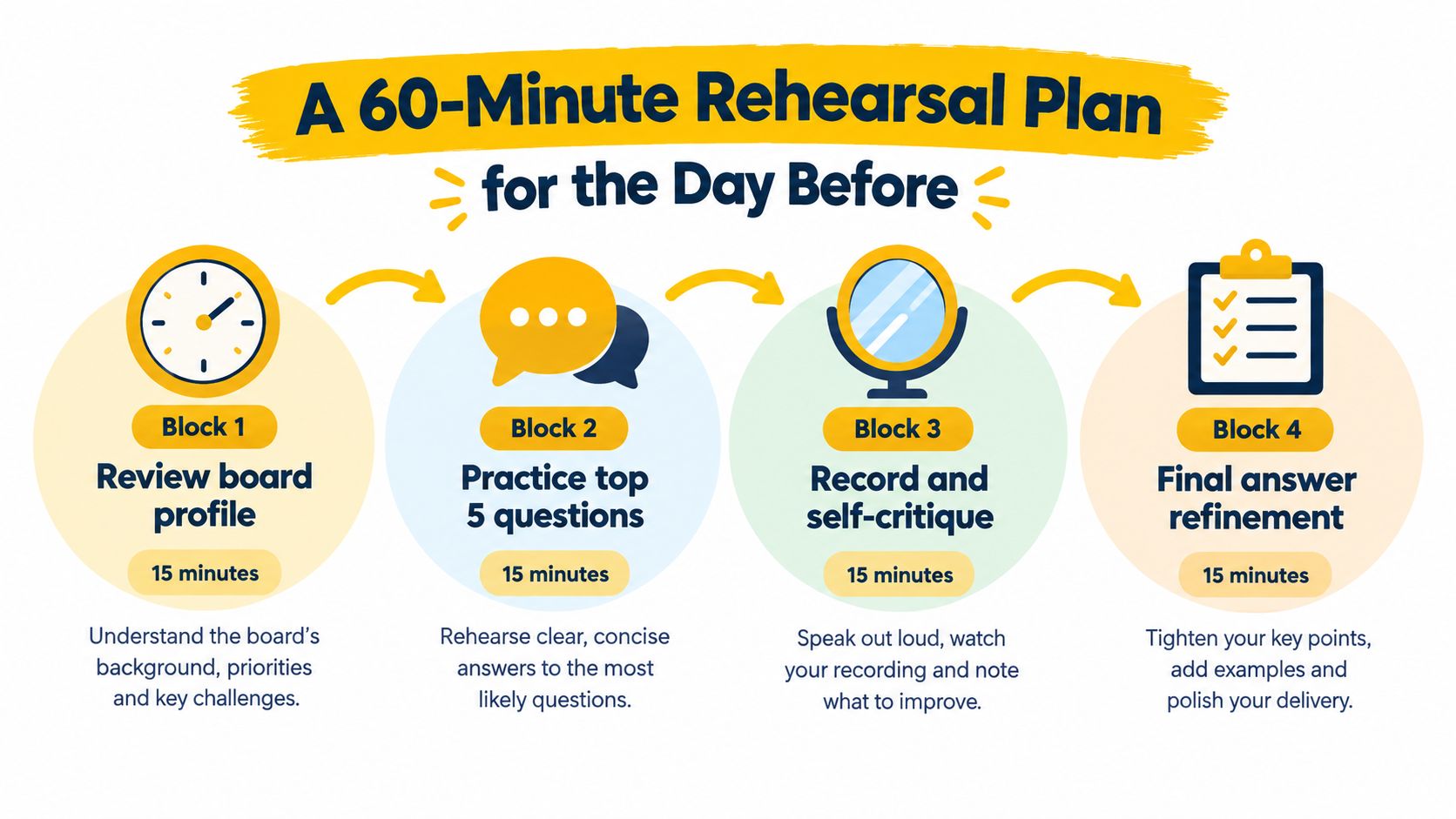
Run the four blocks
- First 15 minutes, organization and market risks: Review the board brief, current priorities, and the assumptions you'd want directors to test.
- Next 15 minutes, committee scenarios: Practice questions tied to the committee and responsibilities relevant to the seat.
- Third 15 minutes, leadership and conflict: Rehearse examples involving difficult decisions, disagreement, ethics, and competing interests.
- Final 15 minutes, questions for the chair: Choose governance questions that reveal how the board works and where it needs stronger contribution.
Then red-team each answer. Check whether it suggests management interference, weak financial literacy, an undisclosed conflict, inadequate time capacity, or inability to challenge a dominant chair or CEO. Revise answers that wander into technical detail or describe only individual execution.
A multi-stage process calls for consistency, not robotic repetition. A committee chair may probe technical oversight; the executive chair may test judgment and fit; other directors may focus on how you'll work with the existing board. Keep the underlying evidence steady, but tailor the emphasis to each person's remit. If you want to compare support options, consider how board coaches and CV writers differ from board-specific interview preparation.
Closing Strong Without Asking the Wrong Questions
The questions you ask in the final ten minutes tell directors more than most of your answers did. A candidate who asks about strategy frameworks sounds like management. A candidate who asks how the board challenges management sounds like a director.
Ask questions that reveal how the board works:
- How does the board test whether it's converging too quickly around a shared view?
- How does the board make sure dissent and material reservations are captured appropriately?
- How does the board balance committee workload and expertise across directors?
- What capability does the board expect to need more of as its priorities evolve?
- How does the chair distinguish constructive challenge from stepping into management's role?
That last question earns its place. It signals you already understand the line between oversight and interference, which is the line boards worry new directors won't respect. Pick questions that fit what you've learned about this specific board, and skip anything designed to sound refined or to smuggle in one more career summary.
Make independence and capacity explicit
Boards may assess a candidate's independence, committee memberships, other directorships, and professional or personal affiliations that could affect judgment. Proxy-governance guidance also identifies the relevance of a candidate's qualifications and experience to oversight of company strategy. Be ready to explain potential conflicts, your realistic time capacity, and how you'd handle a situation that could compromise objectivity. A short independence note keeps your answers consistent when different interviewers probe the same ground.
Don't leave this to improvisation.
Your closing case returns to composition fit: what capability you add, why this board needs it, and how you'll contribute without overstating your role. Executives exploring paid board positions should apply that standard to every opportunity rather than sending the same biography everywhere.
SeatSignal identifies board opportunities, prepares director-grade application materials, and rehearses you for each interview, though no appointment or interview outcome is guaranteed. If you want your experience mapped to a board's actual composition needs, visit SeatSignal.
Want a paid board role, done for you?
One handpicked, verified open board role every week, with a director-grade packet tailored for it.
Get Started